Water Tips
How to Test Your Water Hardness at Home (3 Easy Ways)
Find out how hard your water is using your utility's report, a test strip, or a simple soap test. Here's how each method works, how accurate it is, and how to read the result.
Key takeaways
- Your utility's yearly water quality report is the fastest free way to find your area's average hardness.
- Hardness test strips from a hardware store give a ballpark reading at your own tap in about a minute.
- A soap-and-bottle test tells you if water is hard, but not how hard.
- Convert mg/L or ppm to grains per gallon by dividing by 17.1. Over 10.5 gpg is considered very hard.
Before you can decide whether you need a softener, or what size, you need one number: your water's hardness. Here are three ways to find it, from easiest to most hands-on.
Method 1: Look it up in your water quality report
Every community water system publishes a yearly water quality report (also called a Consumer Confidence Report). Many list total hardness, often in mg/L or ppm. For example, the City of Tampa's 2022 report listed an average of 186 mg/L, about 10.9 grains per gallon.
Pros: free, official, takes a few minutes. Cons: it's an average for the whole system, and some reports don't list hardness at all. See how to read your water quality report.
Method 2: Use a hardness test strip
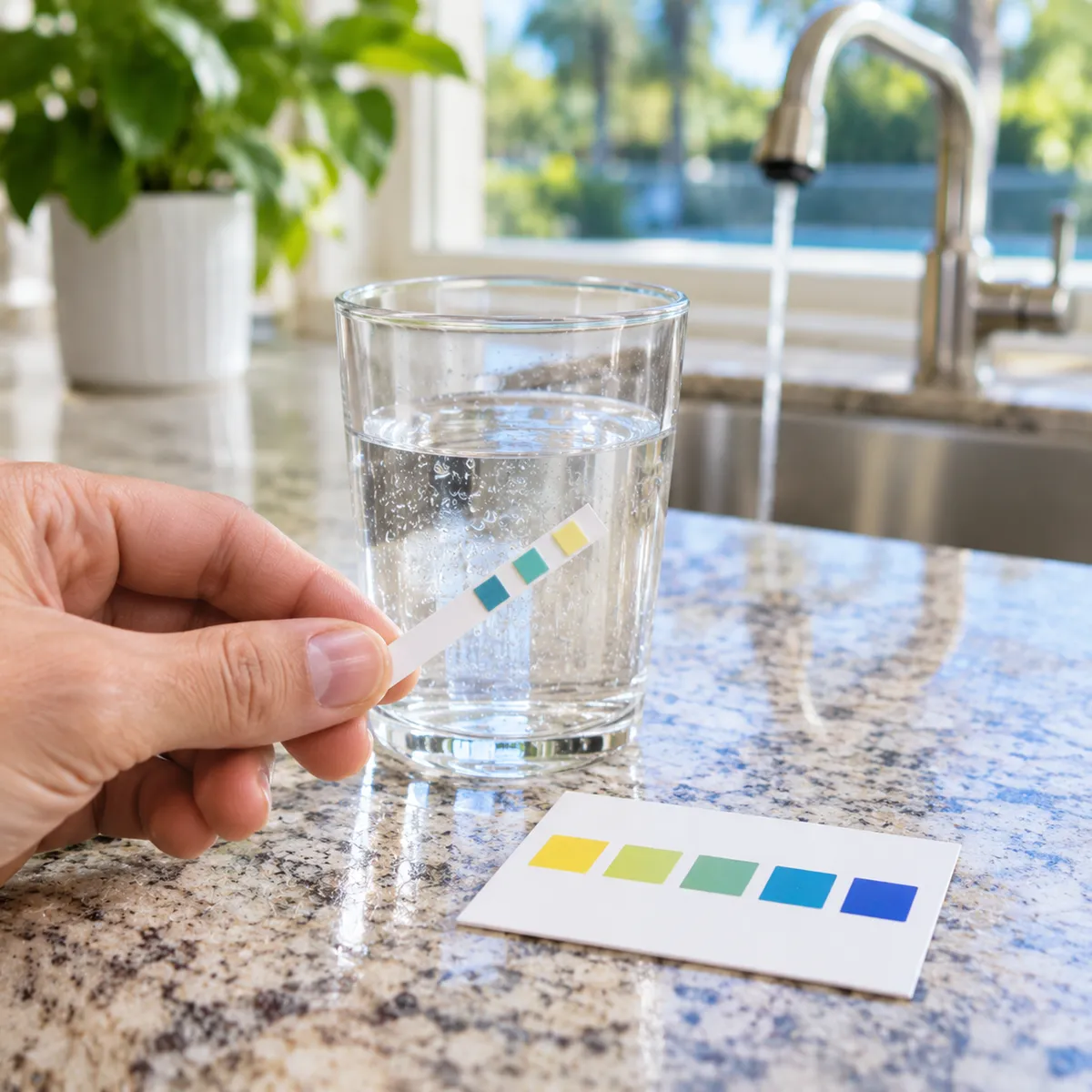
Hardness strips are sold at hardware and pool stores. Dip a strip in a glass of cold tap water, wait the time on the package, and match the color to the chart.
- Use cold water from a kitchen faucet that isn't softened or filtered.
- Let the water run for a few seconds first.
- Read the color in good light, right at the time the package says.
Pros: quick, cheap, measures your own tap. Cons: color steps are wide, so treat the result as a range.
Method 3: The soap bottle test
Fill a clear bottle one-third full of tap water, add a few drops of pure liquid soap (not detergent), cap it, and shake hard for 10 seconds. Soft water makes lots of fluffy suds and clear water underneath. Hard water makes few suds and cloudy, milky water.
Pros: free, uses what's in your kitchen. Cons: it tells you whether water is hard, not how hard, so it can't size a softener.
How to read your number
The U.S. Geological Survey classifies hardness like this:
| mg/L (ppm) | Grains per gallon | Classification |
|---|---|---|
| 0 to 60 | 0 to 3.5 | Soft |
| 61 to 120 | 3.6 to 7.0 | Moderately hard |
| 121 to 180 | 7.1 to 10.5 | Hard |
| Over 180 | Over 10.5 | Very hard |
To convert mg/L or ppm to grains per gallon, divide by 17.1. Then plug your number into our softener size calculator.
Want an exact reading?
Our free in-home water test checks your raw tap water for hardness, chlorine or chloramine, pH and dissolved minerals, and we explain every number in plain English. No pressure. Call or text (727) 334-0333 anytime to set it up.
Frequently asked questions
How can I tell if my water is hard without a kit?
Shake a few drops of pure liquid soap with tap water in a clear bottle. Few suds and cloudy water mean hard water. It won't tell you how hard, though.
Are hardness test strips accurate?
They're good for a ballpark. The color steps are wide, so read the result as a range rather than an exact number.
What is a good hardness level?
Under about 3.5 grains per gallon (60 mg/L) is considered soft. Over 10.5 grains per gallon (180 mg/L) is very hard by the U.S. Geological Survey's scale.
Sources
- Hardness of Water, U.S. Geological Survey
- Consumer Confidence Reports (CCR), U.S. EPA
- 2022 Water Quality Report, City of Tampa Water Department
We check local facts against official sources such as utility water quality reports and government notices. Spot something out of date? Text us at (727) 334-0333 and we'll fix it.